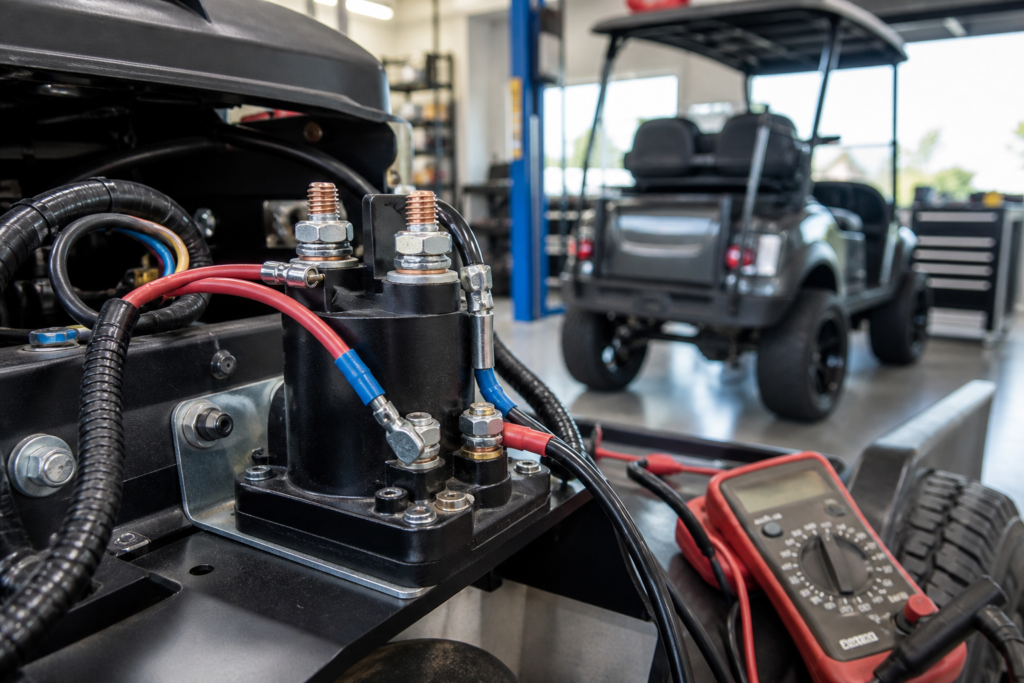
Golf Cart Solenoid problems can quickly turn a leisurely ride into a frustrating standstill. When your golf cart refuses to start, clicks without action, or delivers unreliable performance, a faulty solenoid is often the culprit. Understanding this critical component and knowing how to address its common issues can save you time and money, ensuring your cart remains a reliable companion on the course or around your South Florida community.
This guide will walk you through 7 ultimate fixes for common golf cart solenoid problems. We will explore the symptoms, diagnose the underlying causes, and provide actionable steps to get your cart running smoothly again. From initial troubleshooting to expert replacement services offered by Phoenix Golf Car in Pompano Beach, you will gain the knowledge needed to confidently tackle these essential repairs.
Key Takeaways
- Identify the distinct symptoms of a failing Golf Cart Solenoid, from a simple click to complete silence.
- Understand the differences between electric and gas golf cart solenoids and their specific operational roles.
- Learn practical, step-by-step troubleshooting methods to diagnose common solenoid malfunctions effectively.
- Discover when a simple repair might suffice versus when a full solenoid replacement is necessary for lasting performance.
- Recognize the importance of choosing the correct voltage and type of solenoid for your specific golf cart model.
- Explore how Phoenix Golf Car offers expert diagnostics, high-quality parts, and professional installation services for all major golf cart brands in South Florida.
- Implement preventative maintenance tips to extend the lifespan of your solenoid and avoid future starting issues.
Understanding Your Golf Cart Solenoid: An Essential Component for Smooth Rides
At the heart of your golf cart’s starting system lies the solenoid. This often-overlooked component acts as an electromagnetic switch, serving as the main power relay for your vehicle’s electrical system. When you press the accelerator or turn the key, it connects the battery’s high amperage current to the starter motor (in gas carts) or the controller (in electric carts), allowing the cart to move.
Without a properly functioning solenoid, your golf cart simply won’t start or run. It is a crucial safety and operational component, controlling the flow of high-current electricity in a controlled manner. Phoenix Golf Car specializes in both electric and gasoline-powered golf carts, giving us a deep understanding of how these vital components operate across different models.
What Exactly is a Golf Cart Solenoid?
A solenoid consists of an electromagnetic coil, a plunger, and a set of heavy-duty contacts. When a low-current signal is sent (e.g., from the key switch or accelerator pedal), the coil energizes, creating a magnetic field. This magnetism pulls the plunger, which in turn closes the contacts, completing the high-current circuit from the battery to the motor or controller. This action allows the main power to flow, initiating the cart’s propulsion system.
How Electric and Gas Solenoids Differ (and Similarities)
While both electric and gas golf carts use solenoids, their specific roles and designs can differ. In gas carts, the solenoid primarily functions as a starter relay, engaging briefly to send power to the starter motor to crank the engine. Once the engine starts, the solenoid disengages. For electric carts, the solenoid often acts as a main contactor, staying engaged for longer periods to supply power to the controller as you drive.
Despite these differences, the core principle remains the same: both types are critical for safely switching high-current power. Phoenix Golf Car provides expert maintenance and repair services for all major golf cart brands, ensuring we can diagnose and service the specific solenoid type in your vehicle.
Continuous vs. Intermittent Duty: What You Need to Know
Solenoids are classified as either continuous duty or intermittent duty. Continuous duty solenoids are designed to carry current for extended periods without overheating, making them ideal for electric golf carts where the solenoid remains active while the cart is in motion. Intermittent duty solenoids, on the other hand, are built for short bursts of high current, typically found in gas golf carts where they only engage briefly to start the engine.
Using the wrong type of solenoid can lead to premature failure and potential damage to your electrical system. When you need a replacement, Phoenix Golf Car ensures you get the correct component, offering a wide array of parts and high-performance batteries suitable for any golf cart model.
Critical Problem 1: The Solenoid Clicks, But Nothing Happens
One of the most common and frustrating issues golf cart owners face in South Florida is when the cart’s solenoid clicks, but the cart fails to move or start. This distinct “click no start” symptom indicates that the component is receiving the low-current activation signal and attempting to engage, but it is failing to complete the high-current circuit to the motor or controller.
This problem can often be traced back to several key areas. Understanding these common culprits is the first step toward an effective fix. Phoenix Golf Car technicians are adept at quickly diagnosing these scenarios for all major golf cart brands.
Diagnosing the Dreaded “Click No Start” Scenario
When you hear a click but get no action, it tells you that the control circuit to the solenoid is likely working. The problem usually lies within the solenoid itself or the high-current circuit it controls. This means the solenoid coil is energizing, but the internal contacts are either not closing properly or are unable to pass sufficient current.
You might experience this when you press the accelerator pedal on an electric cart or turn the key on a gas cart. The sound confirms the initial electrical signal is reaching the solenoid, but the critical power transfer is failing.
Common Culprits Behind This Specific Failure
Several issues can cause a clicking solenoid without a start:
- Low Battery Voltage: If your main battery pack is weak or has a dead cell, there might be enough power to activate the solenoid coil (causing the click) but not enough to engage the starter motor or controller. Phoenix Golf Car offers professional battery replacements, including advanced lithium conversions, to ensure your cart has reliable power.
- Corroded or Loose Connections: Poor connections at the solenoid’s large terminals or battery posts can restrict current flow. Even if the solenoid clicks, insufficient power reaches the motor.
- Pitted or Burned Solenoid Contacts: Over time, the internal contacts within the solenoid can become pitted or burned due to arcing. This prevents a clean, strong connection, hindering high-current flow.
- Faulty Solenoid Coil: Less common, but sometimes the coil itself can be weak, allowing it to click but not pull the plunger with enough force to make solid contact.
Initial Troubleshooting Steps for Your Golf Cart
Before calling for service, you can perform a few initial checks:
- Check Battery Charge: Ensure your golf cart batteries are fully charged. A simple voltmeter can confirm the overall pack voltage.
- Inspect Battery Terminals: Look for corrosion or loose connections on your battery posts. Clean and tighten them if necessary.
- Inspect Solenoid Terminals: Similarly, check the four terminals on your solenoid for any signs of corrosion or looseness.
If these basic checks do not resolve the issue, it is time for a more in-depth diagnosis. Phoenix Golf Car in Pompano Beach, FL, provides expert diagnostics to pinpoint the exact cause of your golf cart’s starting problems.
Critical Problem 2: Complete Silence – No Click, No Start from Your Solenoid
When your golf cart gives you absolutely no response – no click, no hum, no movement – it often points to a problem upstream of the solenoid, or a complete failure of the component itself. This “dead cart” scenario can be more challenging to diagnose initially because there is no audible feedback from it attempting to engage. It suggests a complete interruption of the low-current control signal or a total power loss to the unit.
Phoenix Golf Car technicians are experienced in troubleshooting these complex electrical issues for all types of golf carts, from standard models to customized luxury upgrades.
When Your Solenoid Shows No Signs of Life
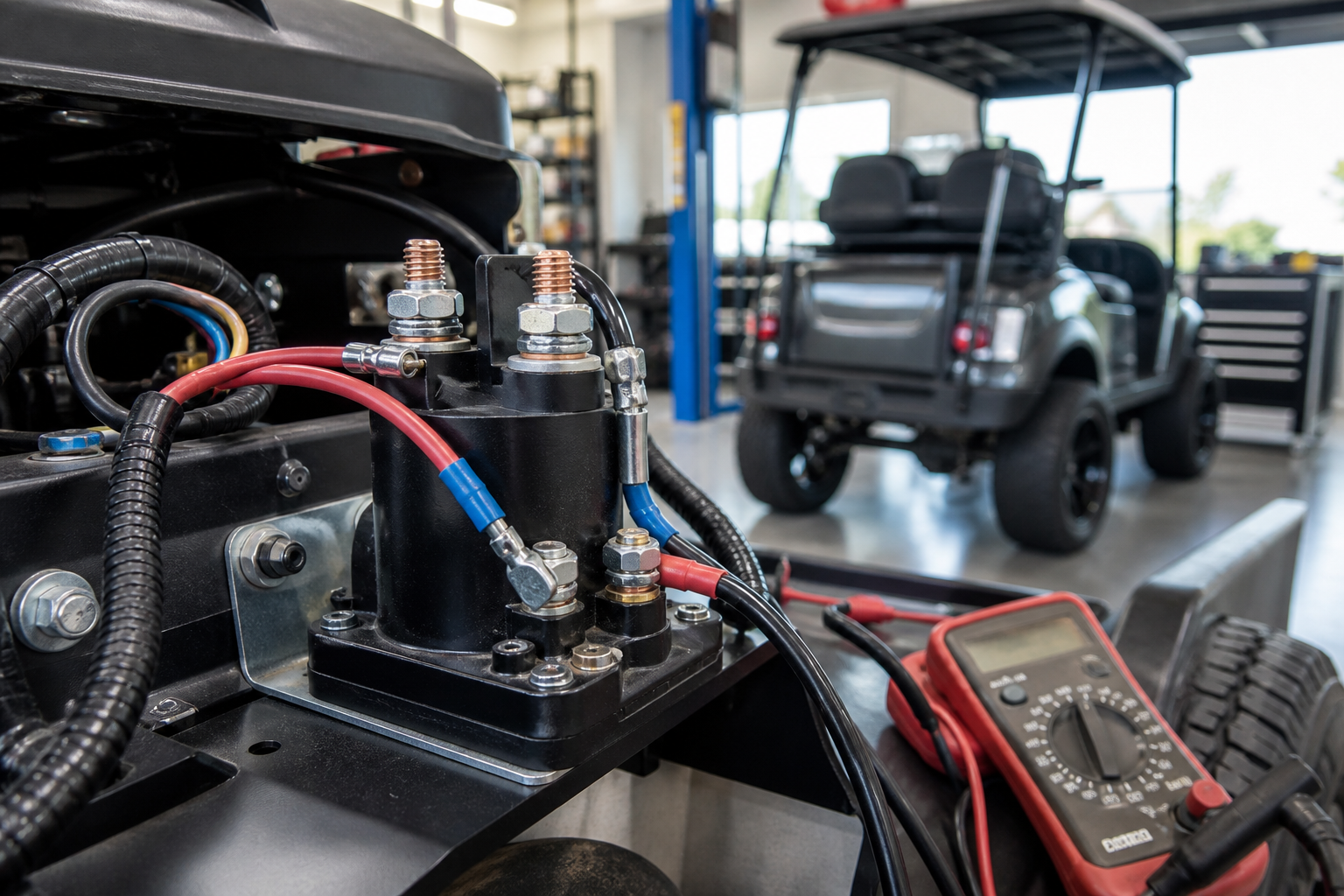
A silent solenoid means the electromagnetic coil inside is not receiving the small amount of current needed to activate it. This could be due to a lack of power from the main battery, an issue with the key switch, the accelerator pedal switch, or a safety interlock. Unlike the “click no start” problem, here the solenoid isn’t even trying to work.
This situation often requires a systematic approach to trace the electrical path and identify where the circuit is broken. Our team at Phoenix Golf Car is equipped with the tools and expertise to perform these detailed electrical inspections.
Identifying Electrical and Mechanical Causes
Potential causes for a completely silent solenoid include:
- Dead Main Battery Pack: If your primary batteries are completely discharged or severely faulty, no power will reach any part of the electrical system, including the solenoid. Phoenix Golf Car offers comprehensive battery services, including professional lithium conversions, to ensure your cart has optimal power.
- Faulty Key Switch: The key switch is the first point of contact for the control circuit. If it is damaged or worn, it may not send the activation signal to the solenoid.
- Blown Fuse: Many golf carts have a small fuse in the control circuit that protects the solenoid. A blown fuse will cut power to the solenoid, resulting in silence.
- Faulty Accelerator Pedal Switch (Electric Carts): In electric carts, the accelerator pedal often contains a microswitch that triggers the solenoid. If this switch fails, the solenoid won’t activate.
- Wiring Issues: Loose, corroded, or broken wires in the low-current control circuit can prevent the signal from reaching the solenoid.
- Safety Interlock Malfunction: Some carts have safety switches (e.g., in the forward/reverse shifter or seat) that prevent starting if not engaged correctly.
What to Check First for Total Power Loss
When faced with complete silence, begin by:
- Verifying Main Battery Voltage: Use a voltmeter to check the overall voltage of your battery pack. Ensure it is at the correct level for your 36V, 48V, or 72V system.
- Checking Fuses: Locate and inspect any fuses related to the starting or control circuit. Replace any blown fuses.
- Inspecting Key Switch: Ensure the key switch feels solid and operates correctly. You can test for voltage at the solenoid’s small terminals when the key is turned.
If these initial checks don’t reveal the problem, the issue might be deeper within the wiring or other components. Phoenix Golf Car offers comprehensive diagnostics and repair services for all major golf cart brands, including authorized Madjax X-Series and E-Series models, ensuring your cart receives the precise attention it needs.
Critical Problem 3: Intermittent Performance & Unreliable Solenoid Function
Few things are more frustrating than a golf cart that works sometimes but not always. Intermittent performance from your solenoid can be particularly challenging to diagnose, as the problem may not present itself consistently. This unreliability can leave you stranded unexpectedly, whether you are on the golf course or simply cruising around your Pompano Beach neighborhood.
Such sporadic failures often point to issues that are not a complete break in the circuit but rather a weak or inconsistent connection. Phoenix Golf Car understands the nuances of these elusive problems and provides thorough inspections to uncover their root causes.
Why Your Solenoid Works Sometimes But Not Always
Intermittent solenoid function typically suggests that the electrical path is partially compromised. It could be due to vibrations causing a loose connection to momentarily break, or components that are failing under specific conditions, such as heat or a particular load. This inconsistency makes it difficult to pinpoint the exact fault without systematic testing.
Imagine your cart starting perfectly fine for several days, then suddenly failing to engage for a few attempts before working again. This pattern is a classic sign of an intermittent solenoid issue.
The Frustration of Sporadic Failures
Sporadic failures are frustrating because they erode your confidence in your golf cart’s reliability. You might find yourself hesitant to take it on longer trips, always wondering if it will start when you need it most. This unreliability can significantly detract from the enjoyment and convenience your golf cart provides.
At Phoenix Golf Car, we prioritize getting your cart back to consistent, dependable operation. Our team is equipped to handle everything from routine inspections to full vehicle rebuilds, ensuring every component, including your solenoid, performs as expected.
Tracing Connections and Component Fatigue
When a solenoid performs intermittently, we typically look for:
- Loose or Corroded Wiring: Even a slightly loose wire connection at the solenoid terminals, key switch, or accelerator pedal can cause intermittent contact. Corrosion, which can build up over time in the humid South Florida climate, can also create resistance that prevents consistent current flow.
- Worn Internal Contacts: The internal contacts of the solenoid can become worn or pitted, leading to inconsistent connections. Sometimes they make contact, sometimes they don’t, especially if the plunger doesn’t always strike with full force.
- Weak Solenoid Coil: A coil that is beginning to fail might not always generate a strong enough magnetic field to pull the plunger firmly, leading to inconsistent engagement.
- Failing Microswitches: In electric carts, the microswitches in the forward/reverse shifter or accelerator pedal can become worn, leading to intermittent signals to the solenoid.
Tracing these connections requires patience and specialized tools. Phoenix Golf Car offers a wide array of parts, high-performance batteries, and chargers, ensuring we have the right components to address any intermittent issue your golf cart may have.
Critical Problem 4: Overheating or Visibly Damaged Solenoid
While often hidden from view, your solenoid can show clear signs of distress through overheating or visible physical damage. These symptoms are critical indicators that the component is under severe strain or has already failed, requiring immediate attention. Ignoring an overheating or damaged unit can lead to further electrical problems or even safety hazards for your golf cart.
Phoenix Golf Car technicians are trained to spot these visual cues during routine inspections and provide the necessary repairs or replacements to keep your cart safe and operational.
Signs of a Solenoid Running Too Hot or Physical Wear
An overheating solenoid is a serious warning sign. You might notice:
- A Burning Smell: This is often the most obvious indicator of overheating electrical components.
- Discoloration: The plastic casing or metal terminals of the solenoid may appear discolored, melted, or charred.
- Hot to the Touch: If you can safely touch the solenoid after it has been attempting to engage, and it feels excessively hot, it is likely overheating.
Visible physical damage could include cracked casings, broken terminals, or severe corrosion that has eaten away at the metal. These are clear signs that the solenoid’s integrity has been compromised.
The Dangers of an Overheating Solenoid
An overheating solenoid is not just a sign of component failure; it poses several dangers:
- Fire Hazard: Excessive heat can melt wires, insulation, and surrounding plastic components, potentially leading to an electrical fire.
- Damage to Other Components: The heat can spread, damaging nearby wiring, battery terminals, or even the golf cart’s controller.
- Complete Electrical System Failure: A solenoid that melts down can short-circuit the entire electrical system, causing extensive and costly damage.
Addressing an overheating solenoid promptly is crucial for the safety and longevity of your golf cart. Phoenix Golf Car offers expert maintenance and repair services, including thorough electrical system checks, to prevent such dangerous situations.
Preventative Maintenance to Extend Solenoid Life
While solenoids eventually wear out, you can extend their lifespan with simple preventative maintenance:
- Regularly Inspect Connections: Periodically check all battery and solenoid terminals for tightness and corrosion. Clean them with a wire brush and apply a dielectric grease to prevent future buildup, especially in the humid South Florida environment.
- Ensure Proper Battery Health: A weak battery forces the solenoid to work harder, leading to premature wear. Keep your batteries charged and in good condition. Phoenix Golf Car provides comprehensive battery services, from testing to professional lithium conversions.
- Avoid Overloading Your Cart: Operating your golf cart beyond its recommended load capacity can strain the entire electrical system, including the solenoid.
- Professional Inspections: Schedule regular maintenance checks with Phoenix Golf Car. Our technicians can identify early signs of wear on your solenoid and other critical components before they lead to major failures. We service all major golf cart brands, including authorized Madjax X-Series and E-Series models.
Your Ultimate Fixes: Testing, Replacement, and Phoenix Golf Car’s Expert Solutions
Once you have identified a potential issue with your Golf Cart Solenoid, the next step is to accurately test it and determine the best course of action: repair or replacement. Attempting to fix a faulty solenoid without proper testing can lead to misdiagnosis and wasted effort. For reliable solutions, Phoenix Golf Car offers expert services, ensuring your golf cart receives the precise care it needs.
Understanding how to test your solenoid and knowing when to seek professional help are key to maintaining your golf cart’s performance and safety.
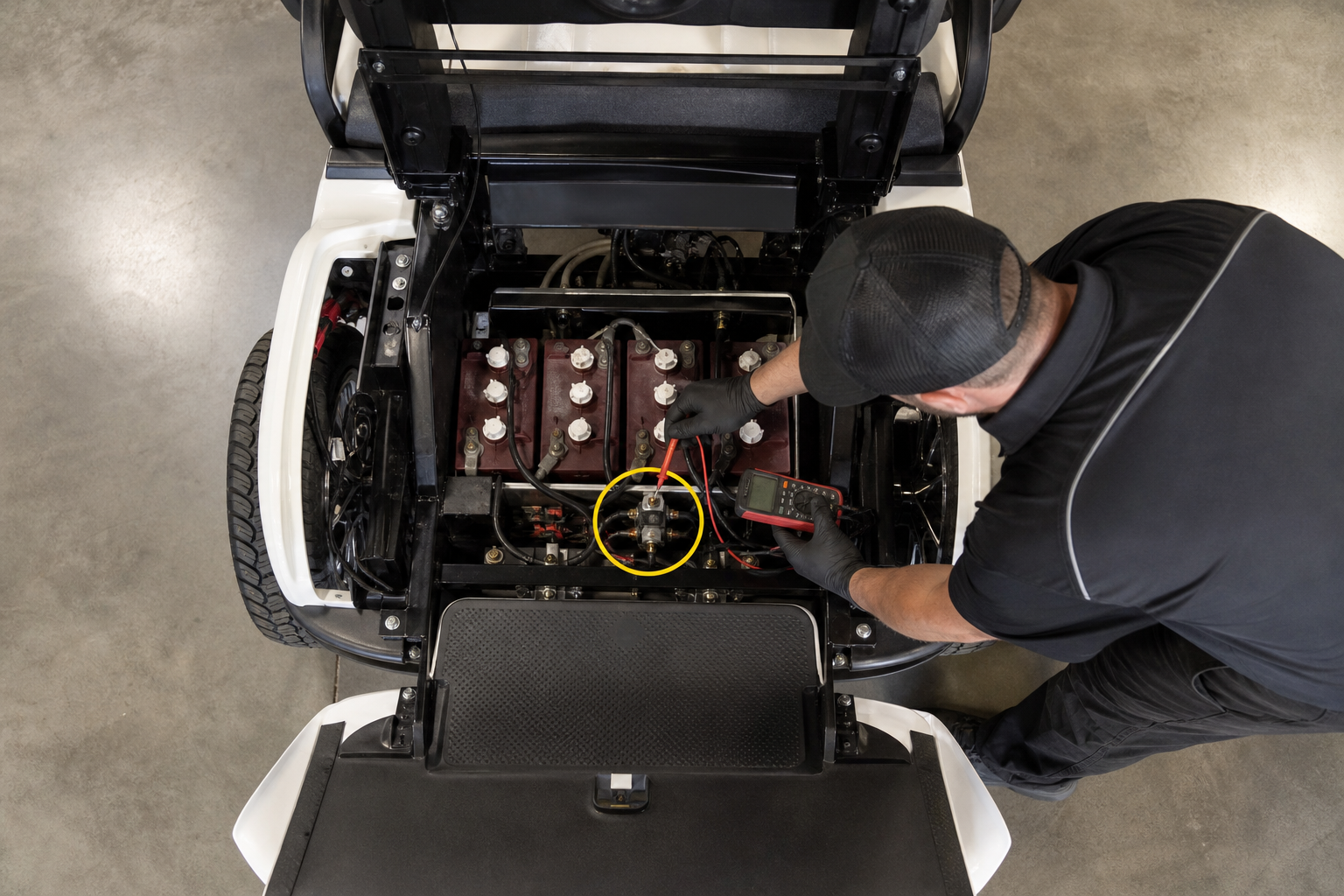
Step-by-Step: How to Safely Test Your Solenoid
Testing your solenoid requires a multimeter and careful attention to safety. Always disconnect the main battery pack before working on electrical components.
- Voltage Test (Control Circuit):
- Set your multimeter to DC volts.
- Connect the negative lead to the main battery’s negative terminal.
- With the key on and accelerator pressed (or cart in neutral for gas carts), touch the positive lead to each of the two small terminals on the solenoid. You should read full battery voltage (e.g., 36V or 48V) at both small terminals. If not, the control circuit (key switch, pedal switch, wiring) has a problem.
- Continuity Test (High-Current Circuit – Solenoid Disconnected):
- Disconnect the main battery pack.
- Disconnect the two large cables from the solenoid’s large terminals.
- Set your multimeter to continuity mode (or ohms).
- Connect one lead to each of the large terminals.
- Have someone activate the solenoid (key on, pedal pressed). A working solenoid should show continuity (a beep or near-zero ohms). If there is no continuity, the internal contacts are faulty.
For a detailed explanation of solenoid operation and testing, you can refer to resources like Electrical4U’s guide on solenoids, which provides foundational knowledge on these electromagnetic switches.
Locating Your Specific Model’s Solenoid
The solenoid is typically located near the battery pack or the motor/controller. Its exact position can vary significantly by golf cart make and model. For instance, on a Madjax X-Series electric cart, it might be easily visible under the seat, while on a gas model, it could be closer to the engine compartment. Always consult your owner’s manual for precise location and wiring diagrams.
If you are unsure, Phoenix Golf Car technicians can quickly locate and access the solenoid on any major golf cart brand.
When Replacement is Necessary vs. a Simple Repair
In most cases, a faulty solenoid needs to be replaced rather than repaired. While minor issues like loose connections or corroded terminals can be cleaned and tightened, internal failures such as a burned-out coil, pitted contacts, or a stuck plunger usually necessitate a full replacement. Attempting to repair internal components can be complex and often isn’t a reliable long-term solution.
Phoenix Golf Car focuses on providing lasting solutions, recommending replacement with high-quality parts when internal damage is detected.
Choosing the Correct Voltage and Type for Your Cart
Selecting the right replacement solenoid is crucial. You must match the solenoid’s voltage (e.g., 36V, 48V, 72V) to your golf cart’s electrical system. Additionally, ensure you choose the correct type: continuous duty for most electric carts and intermittent duty for gas carts. Using an incorrect voltage or type can lead to immediate malfunction or premature failure.
Phoenix Golf Car, an authorized Madjax dealer, carries a wide selection of quality replacement parts suitable for various models. We ensure you get the exact component needed for your specific cart.
Why Phoenix Golf Car is Your Go-To for Solenoid Expertise in South Florida
When your golf cart needs a new Golf Cart Solenoid, you need a trusted partner. Phoenix Golf Car, based in Pompano Beach, FL, offers professional diagnosis, high-quality replacement parts from authorized dealers like Madjax, and expert installation for all major brands. We ensure your cart runs perfectly, providing peace of mind for your rides around South Florida. Our services include not only solenoid replacement but also comprehensive electrical system checks, battery replacements, and even professional lithium conversions.
For quality parts and accessories, visit our Phoenix Golf Car parts page.
Experiencing Golf Cart Starting Issues in South Florida?
Don’t let a faulty solenoid keep you off the course. Phoenix Golf Car offers expert diagnostics and professional solenoid replacement services for all golf cart makes and models.
Get Back on the Green: Partner with Phoenix Golf Car for Solenoid Success
A reliable Golf Cart Solenoid is fundamental to enjoying your golf cart without interruption. From diagnosing that frustrating “click no start” to ensuring your electrical system is performing optimally, understanding this component is key. When you face solenoid issues, remember that expert help is available right here in South Florida.
Phoenix Golf Car is your premier partner for all golf cart solutions in Pompano Beach, FL. We specialize in expert maintenance, repair, and customization for both electric and gasoline-powered vehicles, including authorized Madjax models. Whether you need a simple solenoid replacement, a professional lithium conversion, or a complete vehicle rebuild, our team is dedicated to providing high-quality service and parts.
Don’t let a faulty solenoid keep you off the course or from cruising your community. Contact Phoenix Golf Car today to schedule your service or explore our wide array of parts and customization options. We also offer flexible financing options to make your golf cart ownership experience as smooth as your ride should be.
What is a golf cart solenoid and what does it do?
A golf cart solenoid acts as an electromagnetic switch, serving as the main power relay for your golf cart’s electrical system. When you activate the accelerator or key switch, it connects the battery’s high amperage current to the starter motor (in gas carts) or controller (in electric carts), allowing the cart to move. It’s crucial for safe and controlled power delivery.
How does this crucial component work?
When a low-current signal is sent (e.g., from pressing the accelerator pedal), an electromagnetic coil inside this component is energized. This magnetism pulls a plunger, which closes a set of heavy-duty contacts, completing the high-current circuit from the battery to the motor or controller. This action allows the main power to flow, starting the cart’s propulsion system.
Where is this relay typically located?
This relay is usually found near the battery pack or the controller/motor on most golf carts. Its exact position can vary by make and model, but it’s often a cylindrical or rectangular component with four terminals (two large for battery/motor and two small for control current). Consult your owner’s manual for precise location on your specific cart model.
How much does it cost to replace this part?
The cost to replace this part can vary significantly based on the cart’s make, model, and whether you do it yourself or hire a professional. Components typically range from $30 to $100. Professional installation at a service center like Phoenix Golf Car might add labor costs, ensuring the job is done correctly and safely.
What voltage starter relay do I need for my model?
You must match the starter relay’s voltage to your golf cart’s electrical system voltage. Common golf cart voltages are 36V, 48V, or 72V. Using a relay with an incorrect voltage can lead to malfunction or damage to your electrical system. Always verify your cart’s system voltage before purchasing a replacement component.
Can this electrical switch be repaired, or does it always need replacement?
In most cases, a faulty electrical switch needs to be replaced rather than repaired. While some minor issues like loose connections can be fixed, internal failures such as a burned-out coil or pitted contacts usually necessitate a full replacement. Attempting to repair internal components can be complex and often isn’t a reliable long-term solution.
What is the difference between continuous and intermittent duty relays?
Continuous duty relays are designed to carry current for extended periods, like those in electric golf carts that maintain a circuit while driving. Intermittent duty relays are built for short bursts of high current, typically found in gas golf carts where they only engage briefly to start the engine. Using the wrong type can lead to premature failure.
Do electric and gas carts use the same type of power switch?
While both electric and gas golf carts use power switches, they often require different types. Electric carts typically use continuous duty relays to maintain power to the controller during operation, whereas gas carts use intermittent duty relays that only engage for a brief period to start the engine. It’s crucial to select the correct type for your specific cart. For parts and accessories, visit our Phoenix Golf Car parts page.