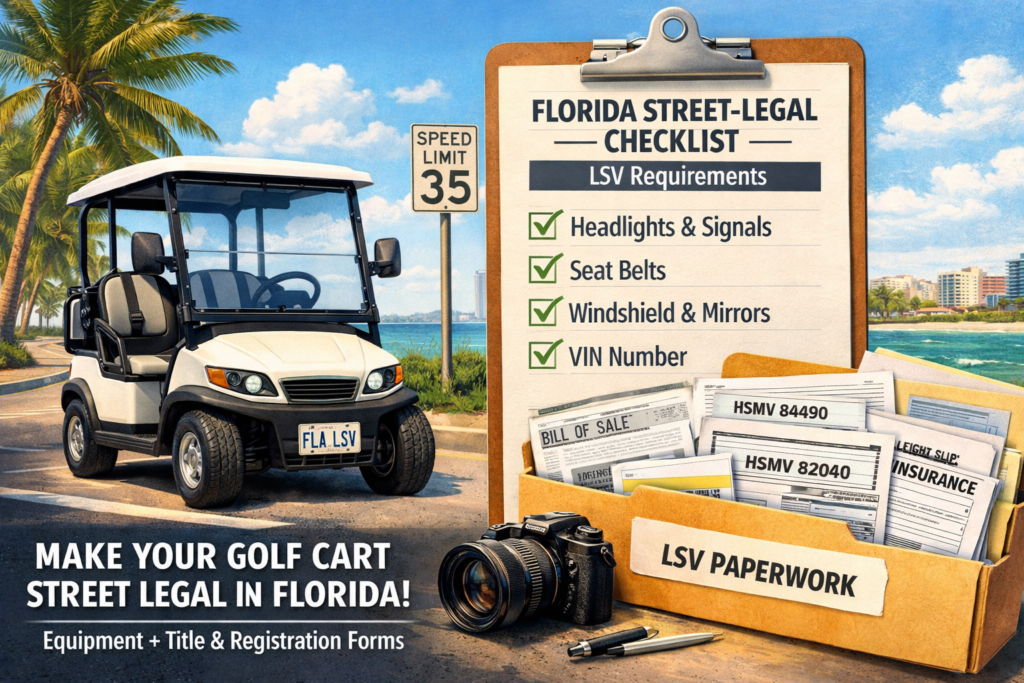
To make a golf cart street legal in Florida, you usually need to convert it into a Low-Speed Vehicle (LSV), which must be titled, registered, and insured, and meet required safety equipment standards (lights, signals, windshield, seat belts, VIN, etc.). Then you’ll take photos of the cart and submit the required forms (including HSMV 84490, HSMV 86064, and HSMV 82040), receipts for conversion parts, a certified weight slip, proof of Florida insurance, and pay applicable fees at a Motorist Services Regional Office for inspection/VIN assignment and registration
Golf cart vs. “street legal” LSV (don’t mix these up)
In Florida, a golf cart is generally a vehicle not capable of exceeding 20 mph, and it may only be used on certain designated roads (often with local rules), typically with lower speed limits and restrictions like daylight operation unless properly equipped.
An LSV (Low-Speed Vehicle) is defined as a 4-wheeled vehicle with a top speed greater than 20 mph but not greater than 25 mph, and it must be registered, titled, and insured (PIP/PDL). LSVs can be operated on roads with posted limits 35 mph or less (with rules for crossings).
Bottom line: If you want true “street legal” use like neighborhoods, many communities, and crossings where allowed, the safest compliance path is typically LSV conversion + registration.
Florida LSV equipment checklist (what your cart must have)
To make a golf cart street legal in Florida as an LSV, Florida’s consumer guidance lists the required equipment, including:
- Headlamps
- Front & rear turn signals
- Stop lamps & tail lamps
- Reflex reflectors
- Mirrors (driver-side + interior or passenger-side)
- Parking brake
- Windshield
- Seat belt for each designated seat
- Vehicle Identification Number (VIN)
The paperwork you’ll need (Florida converted golf cart → LSV)
Florida’s DHSMV guidance for converted golf carts says you’ll bring photos and documentation for inspection/VIN assignment, title, and registration, including:
- Photos of front/back/both sides (4 total)
- MCO or bill of sale for the golf cart
- HSMV 84490 (Statement of Builder)
- HSMV 86064 (Affidavit for Golf Cart Modified to a Low Speed Vehicle)
- Original receipts/bills of sale for conversion parts
- Certified weight slip
- HSMV 82040 (Application for Title)
- Proof of Florida insurance (PIP/PDL minimums listed by FLHSMV)
- Sales tax / exemption info for parts
- Identification (DL/ID/passport)
- Fees (inspection/title/plate/registration, etc.)
Step-by-step: make a golf cart street legal in Florida (simple process)
Inspection + VIN assignment + title/registration submission
Bring your full packet to a Motorist Services Regional Office for inspection/VIN assignment and to complete the title/registration steps.
Decide if you need LSV or golf-cart-only use
If you need broader roadway use, plan for LSV conversion and registration.
Install required LSV safety equipment
Use the checklist above (lights, signals, belts, windshield, mirrors, etc.).
Collect documentation while you build
Save every receipt for parts and keep your bill of sale/MCO—Florida expects original receipts for conversion components.
Get a certified weight slip + take 4 photos
Photos and weight slip are part of the standard packet for converted carts.
Common mistakes that delay approval
- Missing receipts for conversion parts
- Forgetting the 4 required photos
- Not meeting the full equipment list (signals/seat belts are commonly missed)
- Confusing “golf cart operation rules” with “LSV registration requirements” (they’re different)

How Phoenix Golf Car helps (street-legal builds + service + quotes)
If you want the fastest path to compliance, Phoenix Golf Car can help you choose a street-legal-ready cart or plan your upgrades and ongoing maintenance. For service support and fleet/community needs, Phoenix provides mobile maintenance, repairs, and fleet programs in South Florida. Phoenix Golf Car
Get a quote: use the contact form and tell the team your passenger count, where you’ll drive, and whether you need street-legal use.
Florida official guidance: For the latest LSV equipment and converted golf cart paperwork requirements, see the Florida DHSMV Low-Speed Vehicles resource: Low Speed Vehicles (FLHSMV).
Shop street-legal options: Browse our inventory here: Street Legal Golf Carts.
Need installation or inspection-ready help? Explore service options here: Golf Cart Service in Pompano Beach.
Request a quote: Tell us where you’ll drive and what you need: Contact Phoenix Golf Car.
Florida Street-Legal Golf Cart FAQ
Quick answers about how to make a golf cart street legal in Florida, LSV rules, and the paperwork you’ll need.